> For the complete documentation index, see [llms.txt](https://docs.connect.jfrog.io/llms.txt). Markdown versions of documentation pages are available by appending `.md` to page URLs; this page is available as [Markdown](https://docs.connect.jfrog.io/administration-new-ui/general-settings/audit-log/export-audit-log.md).
# Export Audit Log
In JFrog Connect, you can export the audit log to a file in either CSV or JSON format.
JFrog Connect enables you to export an [audit log](/administration-new-ui/general-settings/audit-log.md) to a file, which can be in either CSV or JSON format. The data you can export includes the last 30 days, and there is no limit on the file size.
Exporting the audit log is available to customers who have [Jfrog Artifactory](https://jfrog.com/artifactory/) and to Administrator users only.
To export data from the audit log, do the following:
1. Go to General Settings in the left navigation pane and click the **Audit Log** tab.
2. Hover you mouse over the **Export** button on the top right of the table.
3. Choose the data format for the file. The file will download and will automatically be compressed as a GZIP file.
## Sample Output
The following is an example of the columns and data output in the CSV file. This example is displayed in Google Sheets.
The columns in the CSV file appear slightly differently from the columns that appear in the web UI.
* `Actor_fqn` shows the actor type (e.g., user, device, API), a slash, and then the user’s email or UUID. In the table in the web UI, this information is presented in two separate columns: Actor Type and Actor.
* `Operation` shows the resource category (e.g., Device, App, Alert channel), a period, and then and then the action, e.g., device.update. The web UI displays this as the Resource Type and the Event columns.
* `Resource_fqn` is a combination of the Resource Type (e.g., device), the Project (e.g., demjam), and the Resource columns in the web UI. The Resource is represented by a UUID.
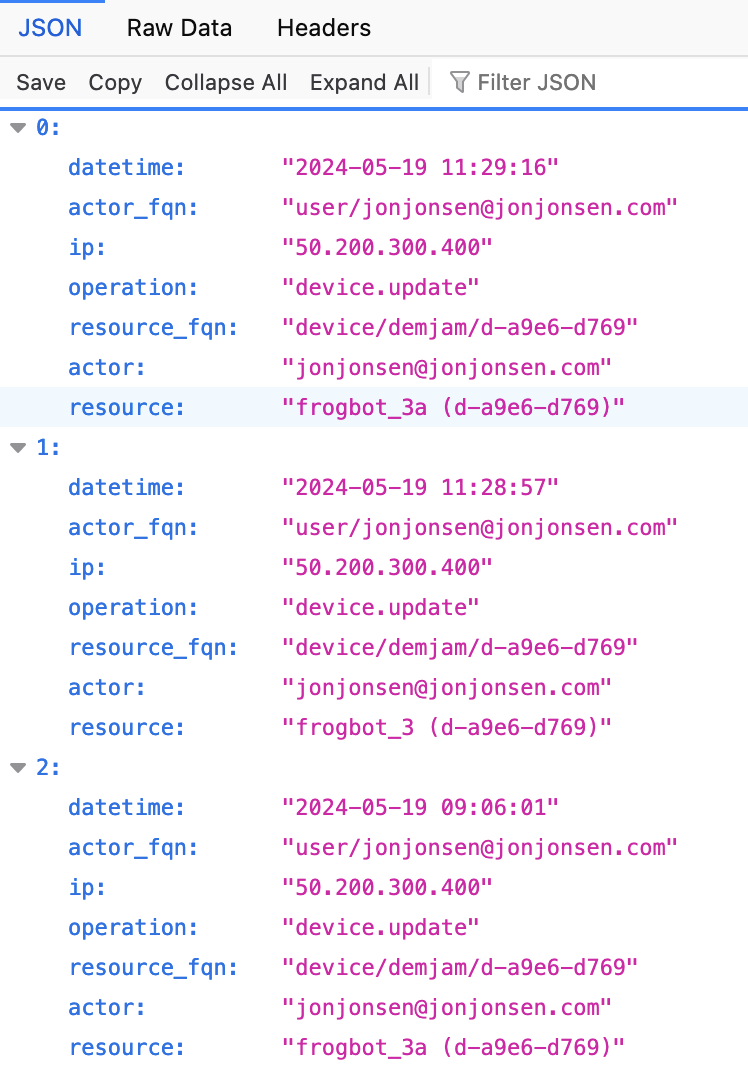
The following is an example of three events in an exported JSON file. This uses `Actor_fqn`, `Operation`, and `Resource_fqn` as keys, and the values are as described above.
## What’s Next?
Learn about [registries and access scoping](/administration-new-ui/general-settings/registry.md).
---
# Agent Instructions
This documentation is published with GitBook. GitBook is the documentation platform designed so that both humans and AI agents can read, navigate, and reason over technical content effectively. Learn more at gitbook.com.
## Querying This Documentation
If you need additional information that is not directly available in this page, you can query the documentation by asking a question.
Perform an HTTP GET request on the following URL with the `ask` and `goal` query parameters:
```
GET https://docs.connect.jfrog.io/administration-new-ui/general-settings/audit-log/export-audit-log.md?ask=&goal=
```
`ask` is the immediate question: it should be specific, self-contained, and written in natural language.
`goal` is what the user is ultimately trying to achieve, the reason they need the answer. Sharing it helps GitBook give you a better, more relevant answer. A goal is most helpful when it describes the outcome the user wants rather than restating the question. For example, with `ask=how do I create an API token`, a goal like `automate deployments from our CI pipeline` lets GitBook tailor the answer to that use case.
The response will contain a direct answer to the question and relevant excerpts and sources from the documentation.
Use this mechanism when the answer is not explicitly present in the current page, you need clarification or additional context, or you want to retrieve related documentation sections.