> For the complete documentation index, see [llms.txt](https://docs.connect.jfrog.io/llms.txt). Markdown versions of documentation pages are available by appending `.md` to page URLs; this page is available as [Markdown](https://docs.connect.jfrog.io/features-new-ui/account-management/organize-your-fleet/create-project.md).
# Create Fleet
Use Fleets to set up completely separate environments within your JFrog Connect account. This page describes how to create and configure a fleet.
[JFrog Connect](https://jfrog.com/connect/) creates the first [fleet](/features-new-ui/account-management/organize-your-fleet.md#fleets) in your Connect account when the account is created. If you need to support multiple Connect environments that have different use cases with different users and permissions defined, you can do this by creating multiple fleets in your account. Each fleet is completely separate and has its own configuration properties.
{% hint style="success" %}
**Tip**: All input parameters in Connect, such as fleet name, group, device, access tokens, etc., are case sensitive.
{% endhint %}
### Step 1: Create a Fleet
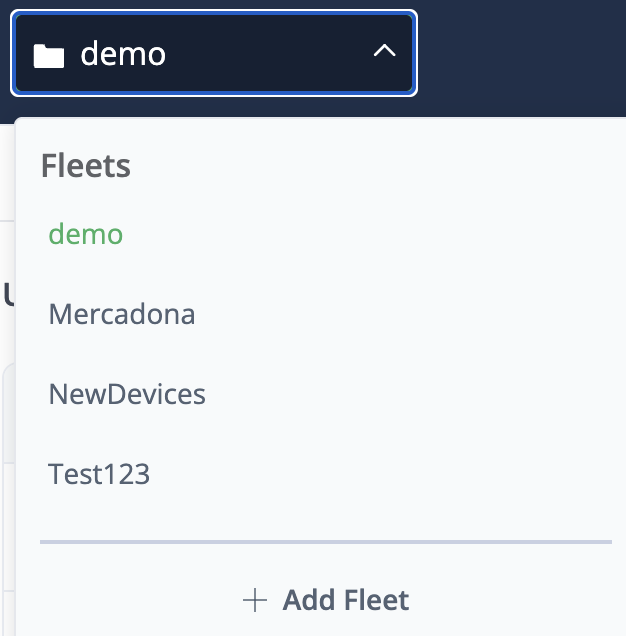
To create a fleet, click the **Fleet** filter on the top left bar, and do the following:
1. In the dropdown menu, choose **Add Fleet**.
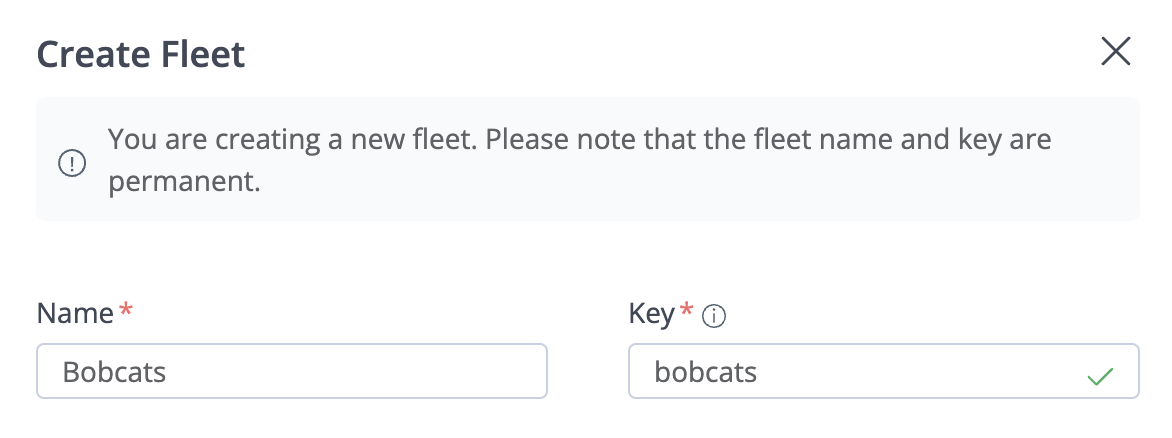
2. Enter the following:
* **Fleet Name**: A name for the fleet that is alphanumeric and does not contain spaces.
* **Fleet Key**: A unique string that identifies your fleet. The fleet key can be used to group together objects that belong to the same fleet, for example, in the audit log. Starting with a letter, the fleet key is lowercase alphanumeric and has 2 to 32 characters.
### Step 2: Configure the Fleet
When Connect creates a fleet, the fleet has default values. You can change these at any time.
* [**Groups**](/features-new-ui/account-management/organize-your-fleet.md#groups): A project is created with two default groups, Test and Production. You can change these or add more groups. For more information about creating, modifying, and deleting groups, see [Create Groups](/features-new-ui/account-management/organize-your-fleet/create-groups.md).
* **Device Locations**: A new fleet will not have any devices assigned to it. However, when a device registers to the fleet, its location is set automatically by geolocation using the public IP address of that device. To reset the location using the current IP address, go to **Fleet Settings** and click **Refresh Location**.
### Step 3: Add Users and Devices
To start populating your new fleet, you need to add some users. You can define Fleet Permissions which are fleet specific, so for example, you can create users who can see only this fleet, and not others. Likewise, you can make your new fleet invisible to some other users in your account.
To add users, go to the procedure in [Add User to New Fleet](https://docs.connect.jfrog.io/administration-new-ui/general-settings/user-management/add-user-from-jpd-artifactory-1/add-user-to-a-project).
There are several options for adding devices to the new fleet:
* To register a new device to the fleet, go to: [Register a Device](https://docs.connect.jfrog.io/get-to-know-new-ui/get-started/register-device-agent-7.0)
* If you are ready to register several devices to the fleet, use one of the procedures in: [Register Devices at Scale](/features-new-ui/account-management/register-linux-devices-at-scale.md)
* If you need to move some devices from an existing fleet to the new one, use one of the procedures in: [Move Device between Fleets](/features-new-ui/account-management/organize-your-fleet/move-a-device/move-many-devices.md).
## What’s Next?
Learn how to [add users](https://docs.connect.jfrog.io/administration-new-ui/general-settings/user-management/add-user-from-jpd-artifactory-1/add-user-to-a-project) to a new fleet.
---
# Agent Instructions
This documentation is published with GitBook. GitBook is the documentation platform designed so that both humans and AI agents can read, navigate, and reason over technical content effectively. Learn more at gitbook.com.
## Querying This Documentation
If you need additional information that is not directly available in this page, you can query the documentation by asking a question.
Perform an HTTP GET request on the following URL with the `ask` and `goal` query parameters:
```
GET https://docs.connect.jfrog.io/features-new-ui/account-management/organize-your-fleet/create-project.md?ask=&goal=
```
`ask` is the immediate question: it should be specific, self-contained, and written in natural language.
`goal` is what the user is ultimately trying to achieve, the reason they need the answer. Sharing it helps GitBook give you a better, more relevant answer. A goal is most helpful when it describes the outcome the user wants rather than restating the question. For example, with `ask=how do I create an API token`, a goal like `automate deployments from our CI pipeline` lets GitBook tailor the answer to that use case.
The response will contain a direct answer to the question and relevant excerpts and sources from the documentation.
Use this mechanism when the answer is not explicitly present in the current page, you need clarification or additional context, or you want to retrieve related documentation sections.