> For the complete documentation index, see [llms.txt](https://docs.connect.jfrog.io/llms.txt). Markdown versions of documentation pages are available by appending `.md` to page URLs; this page is available as [Markdown](https://docs.connect.jfrog.io/features-new-ui/tools/remote-tools-overview/remote-access.md).
# Open Port Tunnel Session
Use JFrog Connect’s port tunneling tool to gain access to your edge device.
JFrog Connect’s Port Tunnel tool enables you to connect remotely to the local network port of your Linux edge device and forward connections such as [VNC](/features-new-ui/tools/remote-tools-overview/remote-access/access-with-vnc.md), [SSH](/features-new-ui/tools/remote-tools-overview/remote-access/connect-with-ssh.md), a [web-view server](/features-new-ui/tools/remote-tools-overview/remote-access/access-device-web-applications.md), and other port-tunneling tools.
The Connect documentation provides example procedures for opening a port tunneling session using VNC, SSH, and a web-view server.
## Prerequisites
* At least one online device.
* For using a remote SSH session, you will need ssh-client installed on the device. (This is installed by default when you download the Connect Agent to the device.)
* Depending on which port tunneling tool you use, you may need additional third-party software installed on your edge device.
{% hint style="success" %}
**Tip**: No ports need to be open on the device or the firewall for port tunneling to work.
{% endhint %}
## Open Port Tunneling Session
To start a port tunneling session, do the following:
1. Go to **Remote Tools**/**Port Tunnel** in the left menu and choose the **Device** you would like to tunnel. Only online devices are shown in the dropdown list.
2. Enter a number for the **Port**. The port will depend on the method of port tunneling you use, for example, VNC, SSH, or Web View.
3. (Optional) Mark **Allowed IP** and enter an IP address. The port will be accessible only from this IP address. If you do not mark this, the allowed IP will be your current IP address.
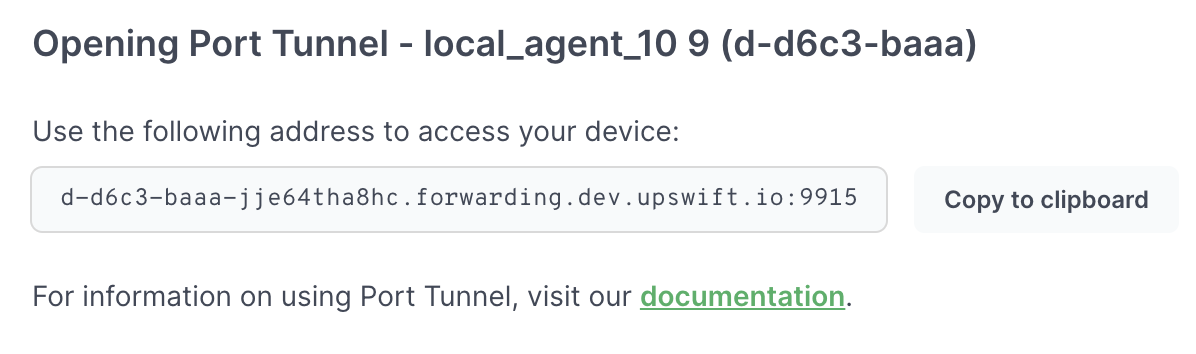
4. Click **Open Session**. Wait until Connect produces the port tunnel address and copy it to your clipboard
4. Continue using the specific instructions for the port tunneling tool you are using. For example, see one of the following procedures: [VNC](/features-new-ui/tools/remote-tools-overview/remote-access/access-with-vnc.md), [SSH](/features-new-ui/tools/remote-tools-overview/remote-access/connect-with-ssh.md), [Web View](/features-new-ui/tools/remote-tools-overview/remote-access/access-device-web-applications.md).
## What’s Next?
See an example of [port tunneling with VNC](/features-new-ui/tools/remote-tools-overview/remote-access/access-with-vnc.md).
---
# Agent Instructions
This documentation is published with GitBook. GitBook is the documentation platform designed so that both humans and AI agents can read, navigate, and reason over technical content effectively. Learn more at gitbook.com.
## Querying This Documentation
If you need additional information that is not directly available in this page, you can query the documentation by asking a question.
Perform an HTTP GET request on the following URL with the `ask` and `goal` query parameters:
```
GET https://docs.connect.jfrog.io/features-new-ui/tools/remote-tools-overview/remote-access.md?ask=&goal=
```
`ask` is the immediate question: it should be specific, self-contained, and written in natural language.
`goal` is what the user is ultimately trying to achieve, the reason they need the answer. Sharing it helps GitBook give you a better, more relevant answer. A goal is most helpful when it describes the outcome the user wants rather than restating the question. For example, with `ask=how do I create an API token`, a goal like `automate deployments from our CI pipeline` lets GitBook tailor the answer to that use case.
The response will contain a direct answer to the question and relevant excerpts and sources from the documentation.
Use this mechanism when the answer is not explicitly present in the current page, you need clarification or additional context, or you want to retrieve related documentation sections.