> For the complete documentation index, see [llms.txt](https://docs.connect.jfrog.io/llms.txt). Markdown versions of documentation pages are available by appending `.md` to page URLs; this page is available as [Markdown](https://docs.connect.jfrog.io/overview/readme/architecture/connect-and-jfrog-platform.md).
# Connect & JFrog Platform
JFrog Platform integration with Connect makes edge devices first-class citizens in a DevOps pipeline, ensuring speed, reliability, and security of software updates with device management at scale.
At the heart of the JFrog Platform is JFrog Artifactory, the industry standard for universal binary repository managers. Artifactory provides end-to-end automation and management of binaries and artifacts throughout the software delivery and deployment process.
## Default JFrog Platform Account
If you already have Artifactory, you can easily add a [JFrog Connect](https://jfrog.com/connect/) license and access them both through the JFrog Platform web UI. This enables you to upload binaries to an Artifactory repository and automatically pull artifacts for deployment to your edge devices.
Connect creates two repositories in your new Artifactory account:
* **Connect-default-docker**
* **Connect-default-generic**
### JFrog Platform Instance
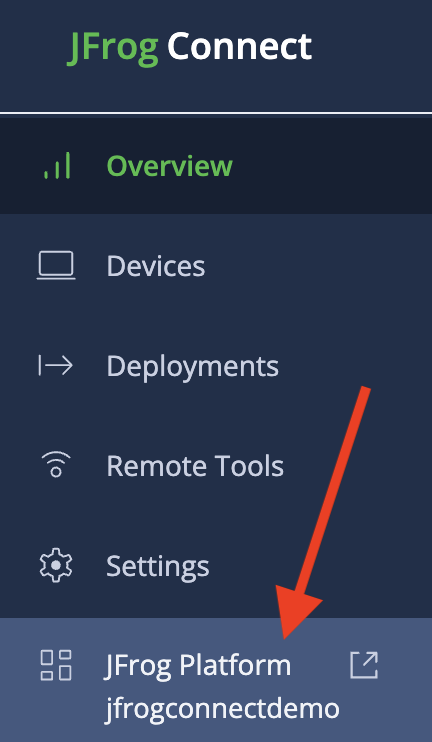
You can find your JFrog Platform instance domain at the bottom of the left navigation bar.
### JFrog Instance Domain before April 2022
If you have registered to Connect before April 2022, do the following to find the JFrog Platform instance domain:
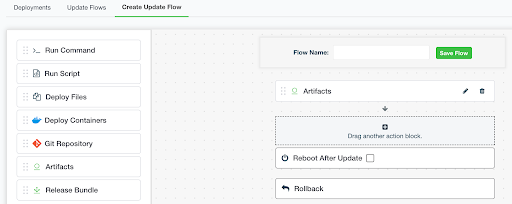
1. In the left sidebar, go to Updates and click the Create Update Flow tab.
2. Ensure the Connect Agent is 6.0.
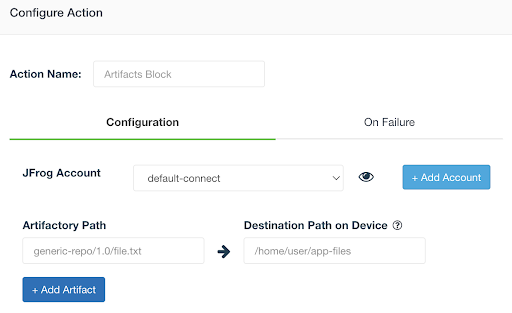
3. Drag and drop the Artifacts action block and click it.
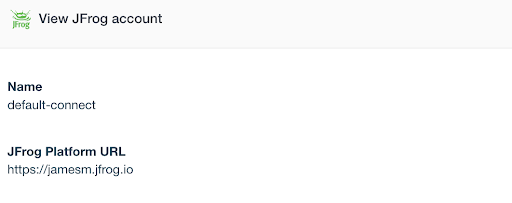
4. Ensure that the JFrog Account field is set to default-connect and click the eye to the right of the field. The instance domain is under JFrog Platform URL.
## JFrog Xray
When you use Connect as an integral part of the full JFrog Platform, you can take advantage of [JFrog Xray](https://jfrog.com/xray/), the universal software composition analysis (SCA) solution. Xray proactively identifies open-source vulnerabilities and license compliance violations before they manifest in production devices.
## Configure Other Registries
Regardless of the default Artifactory instance, you can configure your Connect account to work with a registry other than Artifactory.
To set up Connect to work with a different registry, see [Registry](https://docs.connect.jfrog.io/administration-new-ui/general-settings/registry).
## What’s Next?
[Create a JFrog Connect account](/get-started/getting-started.md) and [register your devices](/get-started/register-device-agent-7.0.md).
---
# Agent Instructions
This documentation is published with GitBook. GitBook is the documentation platform designed so that both humans and AI agents can read, navigate, and reason over technical content effectively. Learn more at gitbook.com.
## Querying This Documentation
If you need additional information that is not directly available in this page, you can query the documentation by asking a question.
Perform an HTTP GET request on the following URL with the `ask` and `goal` query parameters:
```
GET https://docs.connect.jfrog.io/overview/readme/architecture/connect-and-jfrog-platform.md?ask=&goal=
```
`ask` is the immediate question: it should be specific, self-contained, and written in natural language.
`goal` is what the user is ultimately trying to achieve, the reason they need the answer. Sharing it helps GitBook give you a better, more relevant answer. A goal is most helpful when it describes the outcome the user wants rather than restating the question. For example, with `ask=how do I create an API token`, a goal like `automate deployments from our CI pipeline` lets GitBook tailor the answer to that use case.
The response will contain a direct answer to the question and relevant excerpts and sources from the documentation.
Use this mechanism when the answer is not explicitly present in the current page, you need clarification or additional context, or you want to retrieve related documentation sections.