> For the complete documentation index, see [llms.txt](https://docs.connect.jfrog.io/llms.txt). Markdown versions of documentation pages are available by appending `.md` to page URLs; this page is available as [Markdown](https://docs.connect.jfrog.io/features-new-ui/deployments/update-flow/step-types/install-debian-package.md).
# Install Debian Package
Use JFrog Connect to install and update Debian packages on your edge devices easily and securely.
The Install Debian Package step type enables you to install Debian packages onto your edge devices. The step type can be used within an [update flow](/features-new-ui/deployments/update-flow.md) to automate the installation process.
This document describes how to configure an Install Debian Package step type.
## Prerequisites
* At least one device registered with JFrog Connect.
* A local Artifactory repository. Connect does not support remote repositories.
* One or more Debian packages ready for deployment, signed, and stored in your Artifactory repository. To sign the Debian package, see [Sign Debian Metadata](https://jfrog.com/help/r/jfrog-artifactory-documentation/sign-debian-metadata).
* If you are using JFrog as your registry, **Artifactory Project** and **Artifactory Environment** must be set to **All** in the JFrog Registry Scope.
* The repository that you choose must have a signed key. For more information about signing, see [Manage Signing Keys](https://jfrog.com/help/r/jfrog-platform-administration-documentation/manage-signing-keys).
* In the [Create Update Flow](/features-new-ui/deployments/update-flow.md) procedure, completed through Step 3.
## Add a Step and Configure the Step Type
To add a step and configure the step type you have chosen, do the following:
1. In the Create New Flow page, click **Add Step**.
2. In the **Step Type** dropdown list, choose **Install Debian Package**, give the step a **Step** **Name**, and create the step. You can change the step name afterwards if you need to.
3. Choose the **JFrog Registry** where your image is stored. If the registry does not appear in the list, go to [Add JFrog Registry](https://docs.connect.jfrog.io/administration-new-ui/general-settings/registry/add-jfrog-registry) to add yours to the list. Then return to this configuration and the added registry will appear in the list.
Tip: If you want the step to pull content from an Artifactory Edge account, complete the procedure in Add JFrog Registry, and then choose that registry as your JFrog Registry.
3. **Packages**: Enter the **Name** and **Version** of the package. If you leave Version blank, the latest version of the package will be installed. If you want to install more than one package, click **Add**. Add an additional row for each additional package.
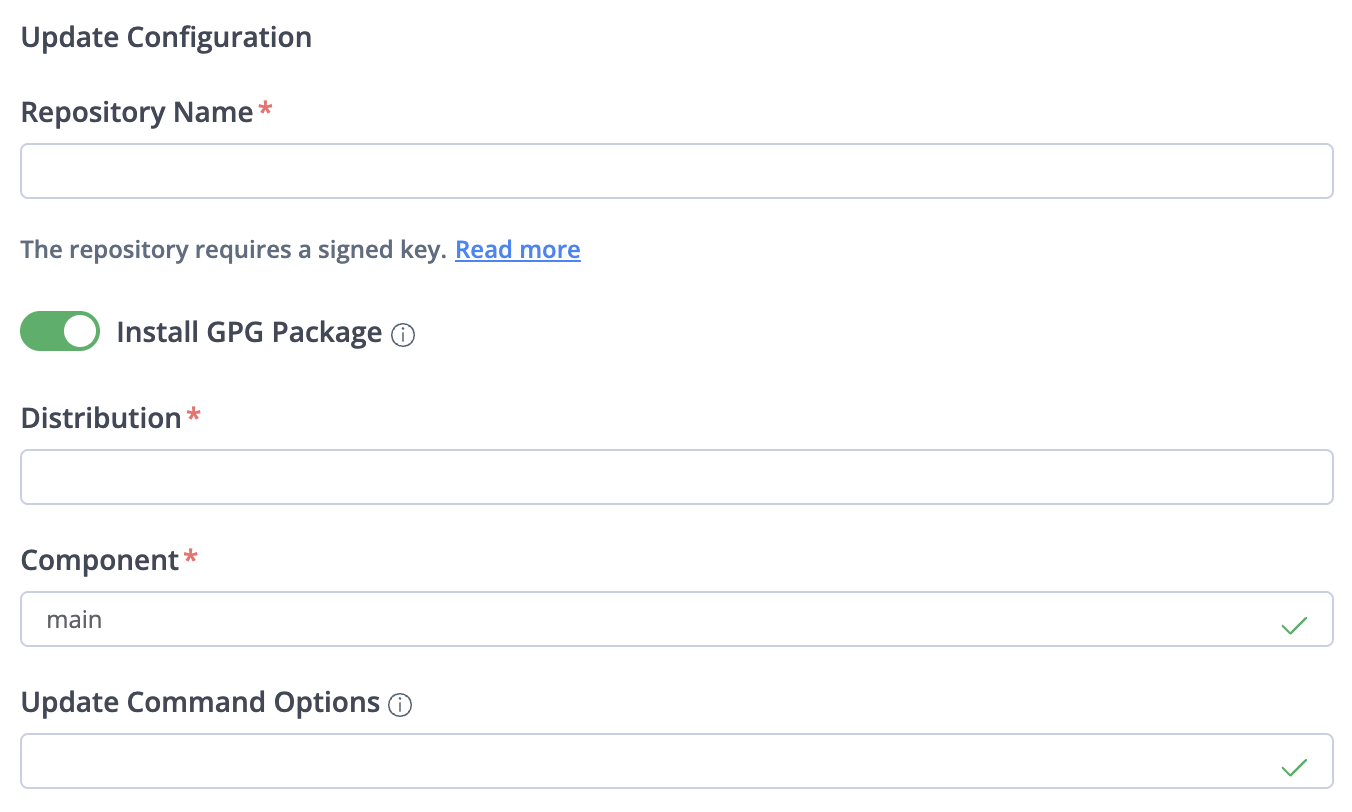
4. Complete the Update Configuration information:
* **Repository Name**: The name of the Artifactory repository containing the Debian package you want to install. The repository that you choose must have a signed key. For more information about signing, see [Manage Signing Keys](https://jfrog.com/help/r/jfrog-platform-administration-documentation/manage-signing-keys).
* **Install GPG Package**: If you do not already have the GPG Package installed on your device, mark this checkbox to install it when you run the software deployment.
* **Distribution**: The appropriate Debian distribution for your target devices (e.g., Debian Buster, Debian Bullseye, Ubuntu Noble, Ubuntu Jammy).
* **Component**: The component (e.g., main, universe, contrib) from which to install the package. The default value is `main`.
* **Update Command Options**: The `apt` or `apt-get` command will be run on the device according to the Linux version. You can add options to tailor the update command to your needs.
{% hint style="success" %}
**Tip**: If you need help finding the parameters above in JFrog Platform, see [Get Artifactory Parameters for Debian](/features-new-ui/deployments/update-flow/step-types/install-debian-package/get-artifactory-parameters-for-debian.md)[.](/features-new-ui/deployments/update-flow/step-types/download-artifacts/get-artifactory-path.md)
{% endhint %}
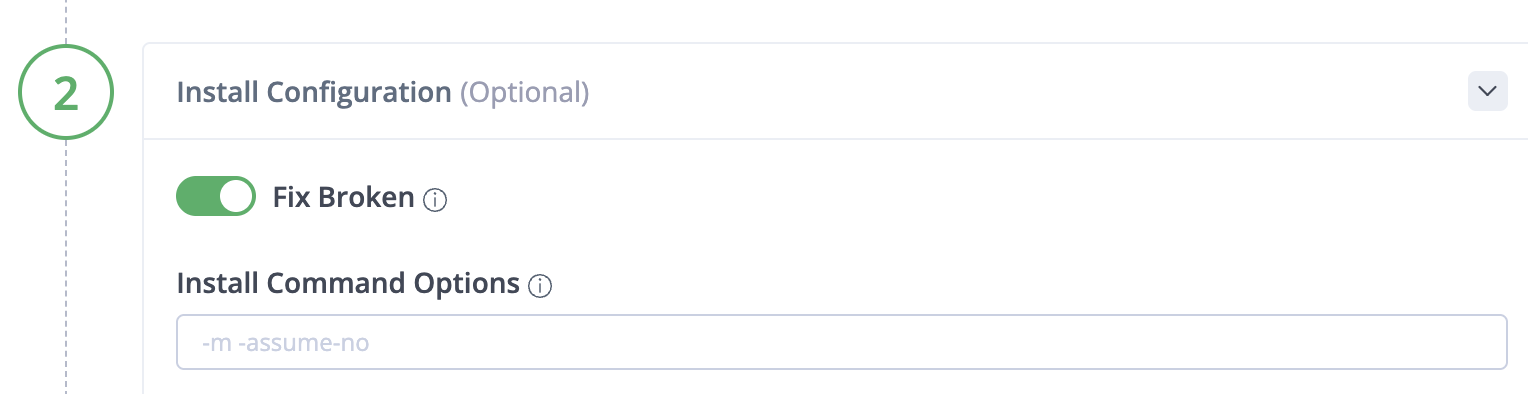
## **Install Configuration (Optional)**
1. **Fix Broken**: Switch this on to run the `apt` or `apt-get` command with the `--fix-broken` option. This can be useful for resolving dependency issues during package installation.
2. **Install Command Options**: The `apt` or `apt-get` command will be run on the device according to the Linux version. You can add options to tailor the install command to your needs. The -y option (equivalent to `--yes` or `--assume-yes`) is set automatically. You can use any of the options supported by the apt package installer.
## Configure On Failure Policy
1. Configure your [On Failure](/features-new-ui/deployments/update-flow/on-failure-and-rollback.md) policy and instructions for rolling back, should a rollback be necessary.
2. Save your step configuration.
## What’s Next?
Learn how to configure your [On Failure](/features-new-ui/deployments/update-flow/on-failure-and-rollback.md) policy in the workflow.
---
# Agent Instructions
This documentation is published with GitBook. GitBook is the documentation platform designed so that both humans and AI agents can read, navigate, and reason over technical content effectively. Learn more at gitbook.com.
## Querying This Documentation
If you need additional information that is not directly available in this page, you can query the documentation by asking a question.
Perform an HTTP GET request on the following URL with the `ask` and `goal` query parameters:
```
GET https://docs.connect.jfrog.io/features-new-ui/deployments/update-flow/step-types/install-debian-package.md?ask=&goal=
```
`ask` is the immediate question: it should be specific, self-contained, and written in natural language.
`goal` is what the user is ultimately trying to achieve, the reason they need the answer. Sharing it helps GitBook give you a better, more relevant answer. A goal is most helpful when it describes the outcome the user wants rather than restating the question. For example, with `ask=how do I create an API token`, a goal like `automate deployments from our CI pipeline` lets GitBook tailor the answer to that use case.
The response will contain a direct answer to the question and relevant excerpts and sources from the documentation.
Use this mechanism when the answer is not explicitly present in the current page, you need clarification or additional context, or you want to retrieve related documentation sections.